


I noticed something strange in my client dashboards last month. Organic traffic was down across the board—even for pages ranking in positions 1-3. Same rankings, fewer clicks. That’s when I realized Google’s AI Overviews had fundamentally changed the game.
If you’re still optimizing content the same way you did in 2023, you’re leaving visibility on the table. The rules have changed, and understanding how to rank in AI Overviews is now essential for anyone serious about organic search.
Here’s everything I’ve learned about getting cited in AI-generated answers—and why it matters more than ever.
The AI Overviews Reality Check
The numbers are stark. According to data from Advanced Web Ranking, AI Overviews now appear in 60.32% of U.S. Google searches as of November 2025. That’s not a niche feature anymore—it’s the default search experience.
More concerning is what happens to clicks. A comprehensive study by Seer Interactive tracked over 25 million organic impressions and found:
| Metric | Change |
|---|---|
| Organic CTR with AI Overviews | Down 61% (1.76% → 0.61%) |
| Paid CTR with AI Overviews | Down 68% (19.7% → 6.34%) |
| Organic CTR even without AI Overviews | Down 41% |
Here’s the silver lining: when your content gets cited in an AI Overview, your organic CTR jumps 35% higher than non-cited results. The question isn’t whether to optimize for AI Overviews—it’s how to get cited.
How AI Overviews Choose What to Cite
Understanding citation patterns is crucial for any ai overviews optimization strategy. Based on multiple industry analyses, here’s what I’ve observed:
76% of cited URLs come from the top 10 organic results. AI Overviews don’t pull from random corners of the internet—they favor already-ranking content. This means traditional SEO still matters. You can’t shortcut your way to AI citations without first earning organic visibility.
Long-tail queries trigger AI Overviews more often. About 53% of searches with 10+ words produce an AI Overview, compared to just 8% of shorter queries. The more specific and complex the question, the more likely Google’s AI is to synthesize an answer.
Authority signals weight heavily. Reddit, YouTube, Wikipedia, and established niche sites get cited disproportionately. Google’s AI trusts the same sources Google’s algorithm has always trusted.
The critical insight here: you don’t optimize for AI Overviews separately from regular SEO. You optimize for both by being the most authoritative, best-structured answer.

5 Strategies to Get Cited in AI Overviews
1. Structure Content for Extraction
AI Overviews don’t read content the way humans do. They scan for extractable answer blocks—self-contained segments that can be quoted directly.
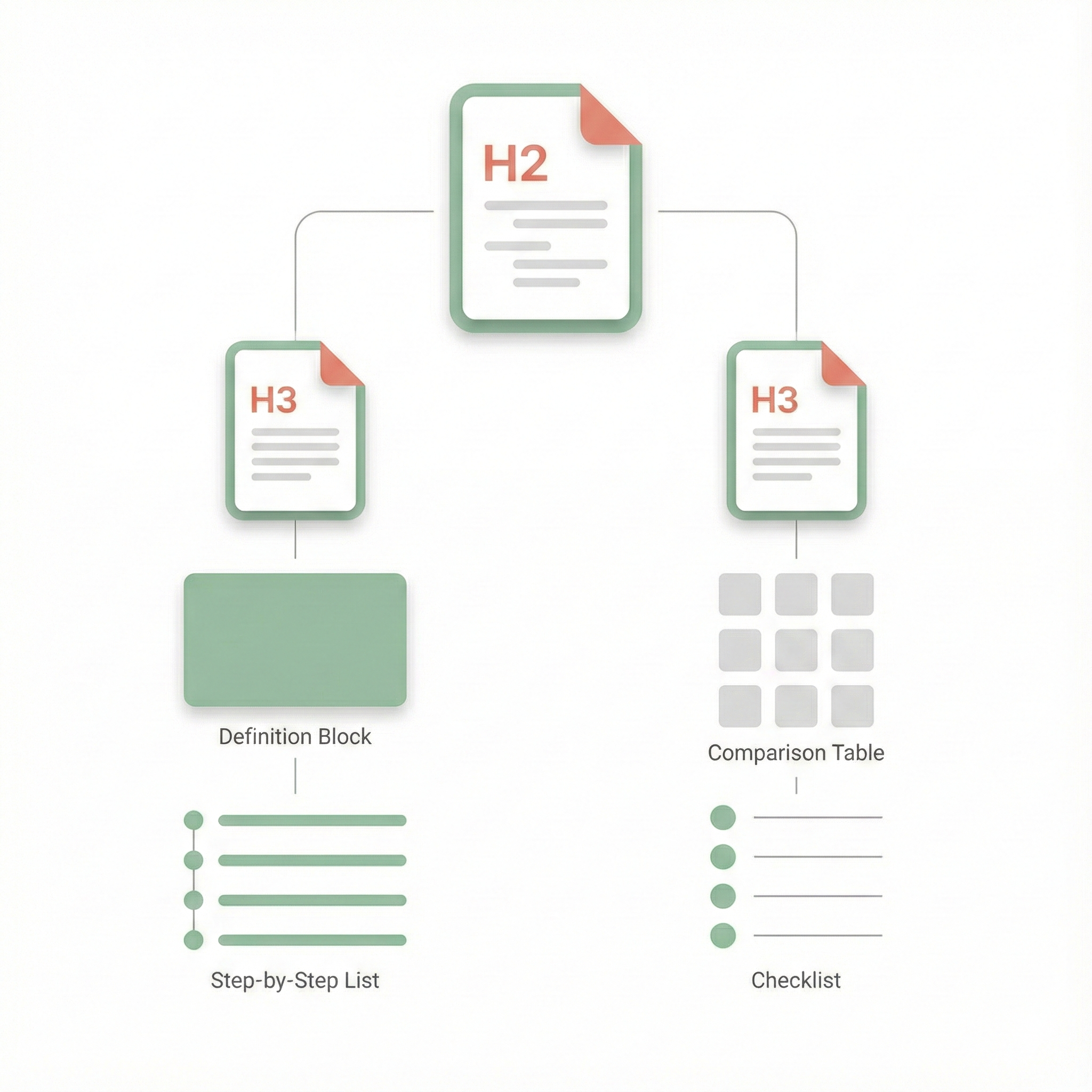
Format your content with these patterns:
- Definition blocks: H2 heading like “What is [topic]?” followed by a 2-3 sentence definition and 3-5 bullet key points
- Step-by-step blocks: Numbered lists with 1-7 concise steps, each step being 1-3 sentences
- Comparison tables: Clear headers comparing options, features, or approaches
- Checklists: Scannable bullet lists with concrete, actionable items
Keep key definitions and answers within 40-60 words. AI Overviews frequently quote verbatim from clean, structured segments rather than wading through dense prose.
2. Demonstrate E-E-A-T Through Format
Google’s AI needs signals that you know what you’re talking about. Here’s how I make expertise machine-readable:
- Author bylines with credentials: Not just a name, but “10+ years in SEO” or “Managed $5M+ in ad spend”
- First-hand experience markers: “I tested…”, “Based on my client work…”, “In my experience…”
- Original data and observations: Screenshots, case studies, specific numbers from real campaigns
- Clear publishing and update dates: “Updated for December 2025” signals freshness
These signals help Google’s AI determine that my content comes from someone who’s actually done the work—not just summarized what others have written.
3. Target Long-Tail, Complex Queries
AI Overviews appear most often for queries where users need synthesized answers. Focus on:
- Multi-step “how to” queries (like this article)
- “What’s the best X for Y” comparisons
- “Is it safe/allowed/legal to…” questions
- Questions that require expertise to answer properly
Build content specifically around 10+ word queries and their variations. These are the queries where AI Overviews dominate—and where citation matters most.
4. Build Topic Clusters That Signal Authority
A single article doesn’t signal expertise. A cluster of interconnected content does.
I use a hub-and-spoke architecture: one comprehensive guide (hub) surrounded by 5-20 supporting articles (spokes) covering specific sub-topics. Internal links connect everything, demonstrating topical depth.
For example, this article connects to my comprehensive guide to content optimization tools, which serves as the hub for my content optimization cluster. Google’s AI sees this connected evidence graph and understands that MKDM has depth on this topic.
5. Expand Your Presence Beyond Your Site
AI Overviews cite content from across the web. If you’re only publishing on your own domain, you’re limiting your surface area.
Contribute thoughtfully on Reddit in relevant subreddits. Create YouTube videos that repurpose your best guides with detailed descriptions and chapters. Write guest posts for industry publications.
When you’re cited in multiple places that Google’s AI already trusts, your overall authority increases—even for your own site’s content.
Content Formats AI Overviews Prefer
Based on what I’ve observed getting cited, certain content formats consistently outperform:
- In-depth guides and explainers that thoroughly cover a topic
- How-to tutorials with clear numbered steps
- Original research, benchmarks, and data studies
- Comparison tables and “best X for Y” roundups
- FAQ sections with direct, concise answers
AI Overviews quote directly from numbered lists and comparison tables more often than prose paragraphs. Structure matters.
Technical Optimization for AI Search
Don’t neglect the technical foundation. Implement structured data that helps Google understand your content:
- Article/BlogPosting schema for main content
- FAQPage schema for Q&A sections
- BreadcrumbList for site navigation
- VideoObject for any video content
Maintain strong Core Web Vitals and mobile usability. Google has explicitly tied AI search performance to general page experience signals. Fast, mobile-friendly pages get cited more.
Tools That Help You Optimize for AI Overviews
The right content optimization software can streamline this process. Look for tools that include AI visibility tracking, content scoring against top SERP results, and structured data validation.
For a comprehensive breakdown of the best options—including those with GEO (Generative Engine Optimization) features—see my complete guide to content optimization tools.
The Bottom Line
AI Overviews aren’t replacing traditional SEO—they’re built on top of it. The sites winning in AI search are the same ones that have always done content right: authoritative, well-structured, genuinely helpful.
The difference now is that structure matters more than ever. Format your content for extraction. Demonstrate expertise through concrete signals. Build topical depth through clusters.
The brands getting cited in AI Overviews in 2025 are those that treat every piece of content as a potential answer to a user’s question. Make your content the answer Google’s AI wants to cite.